




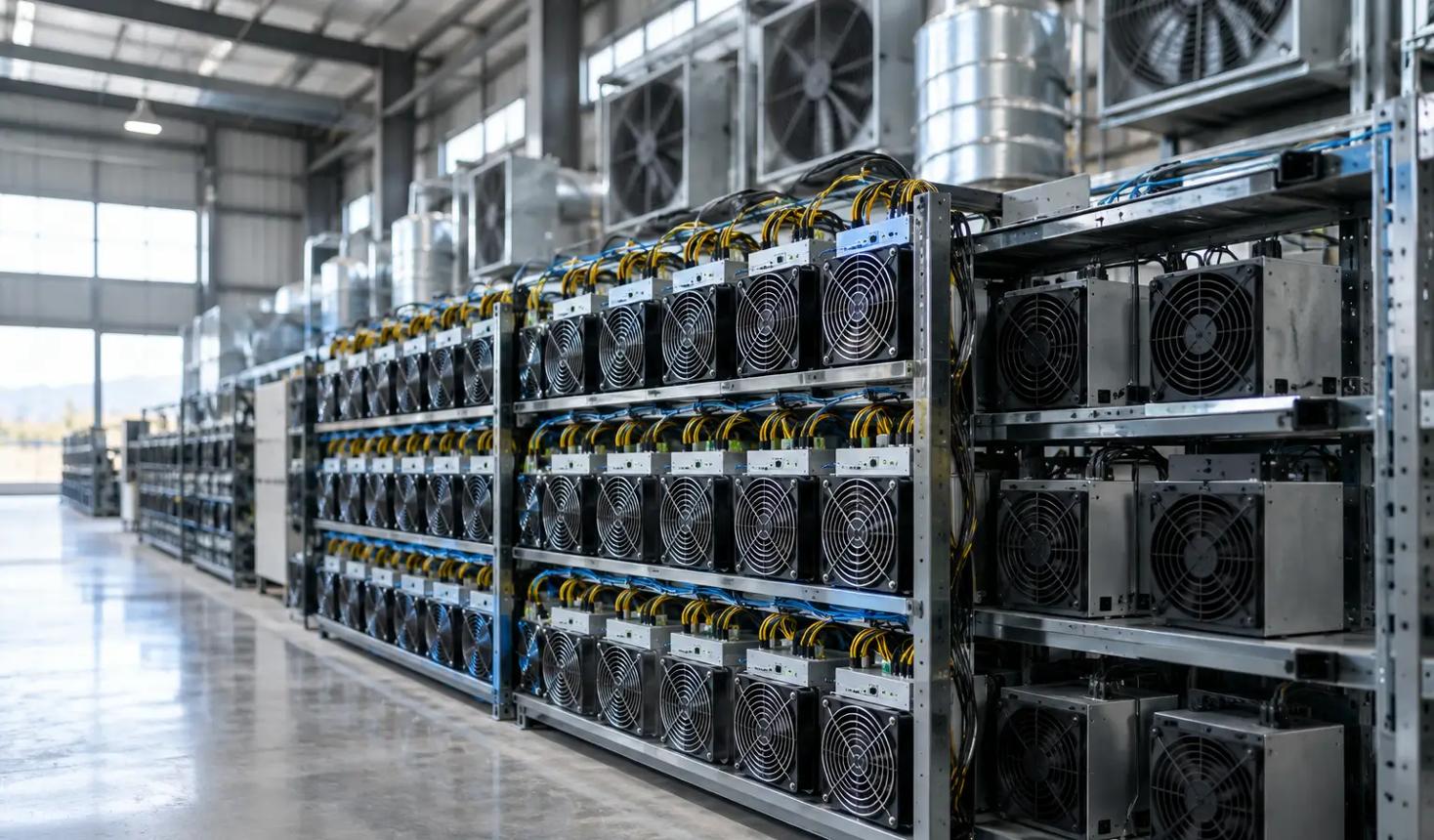
Bitcoin’s mining network has recovered much of its computing power, but the revenue generated by individual mining machines remains under pressure.
Data published by Luxor’s Hashrate Index on November 23, 2026, showed that miners earned an estimated $29.36 per petahash per second of computing power per day, down 3% from $30.27 a week earlier.
At the same time, the network’s seven-day average hashrate increased 7.8% to approximately 1,033 exahashes per second.
The figures highlight a central feature of Bitcoin mining: greater computing power does not necessarily translate into higher profits for the businesses operating the machines.
Bitcoin’s computing power rebounds
Bitcoin miners use specialized computers to perform calculations that help secure the blockchain and confirm transactions.
The combined rate at which these machines perform calculations is known as the network hashrate.
Hashrate is usually measured in exahashes per second (EH/s), representing quintillions of calculations each second.
According to Hashrate Index, Bitcoin’s seven-day average hashrate increased from approximately 959 EH/s to 1,033 EH/s during the week ending November 23.
The 30-day average stood at approximately 1,019 EH/s.
These figures indicate a recovery in estimated computing activity after a period of weaker network participation.
However, a seven-day recovery should not be confused with sustained annual growth.
Glassnode reported on November 24 that Bitcoin’s hashrate was approximately 8% below its level one year earlier.
The two observations measure different periods and do not necessarily contradict one another.
Mining revenue declines despite the recovery
Hashrate alone does not determine how much money miners earn.
A more useful measure of mining economics is hashprice, which estimates the revenue generated by a standardized amount of computing power.
Hashrate Index reported a dollar-denominated hashprice of $29.36 per petahash per second per day on November 23.
That was approximately 3% lower than the previous week’s $30.27.
However, hashprice measured in Bitcoin remained nearly unchanged at approximately 0.0004685 BTC per petahash per second per day.
The distinction is important.
A mining operation can earn approximately the same quantity of Bitcoin while receiving fewer U.S. dollars when the cryptocurrency’s market price declines.
Mining companies generally pay electricity bills, maintenance expenses and other operating costs in conventional currencies.
Lower dollar revenue can therefore weaken their financial position even when their machines continue producing Bitcoin.
Network difficulty changes mining economics
Bitcoin automatically adjusts mining difficulty approximately every 2,016 blocks.
The mechanism is designed to keep average block production close to ten minutes, despite changes in total computing power.
When miners collectively add more computing capacity, blocks may initially be produced faster.
The network can then increase difficulty, making it harder to produce new blocks.
On November 14, Bitcoin’s mining difficulty fell approximately 9.1% to 134.82 trillion.
Following the subsequent hashrate recovery, Hashrate Index estimated on November 23 that difficulty could increase approximately 9.5% around November 26.
That estimate was a projection, not a completed adjustment.
If difficulty increases while Bitcoin’s price, transaction fees and a miner’s computing power remain unchanged, the expected amount of Bitcoin earned by that miner generally declines.
This creates additional pressure on operations with high electricity costs or inefficient machines.
Electricity efficiency determines which miners can survive
Mining equipment consumes substantial electrical power.
Different machines require different amounts of energy to perform the same computational work.
Efficiency is commonly measured in joules per terahash (J/TH).
A machine consuming 13.5 J/TH is more energy-efficient than one consuming 30 J/TH.
Using Hashrate Index’s November 23 revenue estimate, a hypothetical mining operation producing 1 PH/s would generate approximately $29.36 in gross daily revenue.
At 30 J/TH, that computing capacity requires about 720 kilowatt-hours per day.
At 13.5 J/TH, it requires approximately 324 kilowatt-hours.
The corresponding electricity-only break-even rates are approximately 4.08 cents and 9.06 cents per kilowatt-hour.
These are calculated examples, not actual profitability figures for individual mining companies.
They exclude equipment depreciation, repairs, pool fees, financing expenses, hosting charges and other operating costs.
Nevertheless, the comparison demonstrates why two miners operating at the same computing speed can experience very different financial outcomes.
Higher difficulty could narrow margins further
A hypothetical 9.5% increase in difficulty would reduce expected gross revenue from $29.36 to approximately $26.81 per PH/s per day, assuming unchanged Bitcoin prices, transaction fees and mining capacity.
For a 30 J/TH machine, the electricity-only break-even rate would fall to approximately 3.72 cents per kilowatt-hour.
For a more efficient 13.5 J/TH machine, it would fall to approximately 8.27 cents.
These calculations show that less efficient mining equipment may become uneconomic sooner when competition increases.
However, mining profitability cannot be predicted using difficulty alone.
Bitcoin’s market price, transaction fees, equipment uptime and actual electricity contracts also influence revenue and costs.
Transaction fees provide limited additional income
Bitcoin miners receive compensation through block subsidies and transaction fees.
The current block subsidy is 3.125 BTC, following the April 2024 halving.
Transaction fees provide additional revenue when users pay to have transactions included in blocks.
According to Hashrate Index, miners collected an average of approximately 0.0201 BTC in transaction fees per block over the seven days ending November 23.
That represented a 12.2% decline from the preceding week’s average of 0.0229 BTC.
The figures show that transaction fees contributed relatively little compared with the block subsidy during the measured period.
This does not establish that fees will remain low permanently.
Fee revenue changes with transaction demand, network congestion and users’ willingness to pay for block space.
Why mining companies are diversifying
Financial pressure has encouraged several publicly traded Bitcoin mining companies to expand into artificial intelligence and high-performance computing infrastructure.
These businesses already operate large data centers, electrical connections and cooling systems.
Some may be able to adapt portions of that infrastructure to support other computing workloads.
However, AI infrastructure and Bitcoin mining have different equipment, networking, reliability and customer requirements.
A facility suitable for cryptocurrency mining is not automatically ready to support AI training or cloud computing.
Diversification can create additional revenue opportunities, but its financial benefits depend on investment costs, operational execution and customer contracts.
The existence of a new AI strategy does not independently establish that a mining company will become profitable.
What the latest data do not prove
The recent hashrate rebound demonstrates that substantial computing power remains active on Bitcoin’s network.
It does not establish that every mining operation is profitable.
Similarly, declining hashprice indicates reduced expected revenue per unit of computing power, not that all miners are operating at a loss.
Companies with efficient equipment and favorable electricity agreements may remain profitable while less efficient operators experience financial pressure.
The data also do not establish that Bitcoin’s network security has failed or that declining mining profitability will necessarily cause its market price to fall.
Mining economics, network security and cryptocurrency valuation are related but distinct subjects.
Research conclusion
Bitcoin’s mining industry faces a difficult combination of fluctuating market prices, competition for block rewards and substantial energy requirements.
The November data show that network computing power can recover even while dollar-denominated mining revenue remains weak.
The most important distinction is between network-level activity and company-level financial performance.
A powerful Bitcoin network does not guarantee profitable Bitcoin miners.
Understanding the difference requires examining mining difficulty, revenue per unit of computing power, machine efficiency and actual operating expenses rather than relying on hashrate alone.