




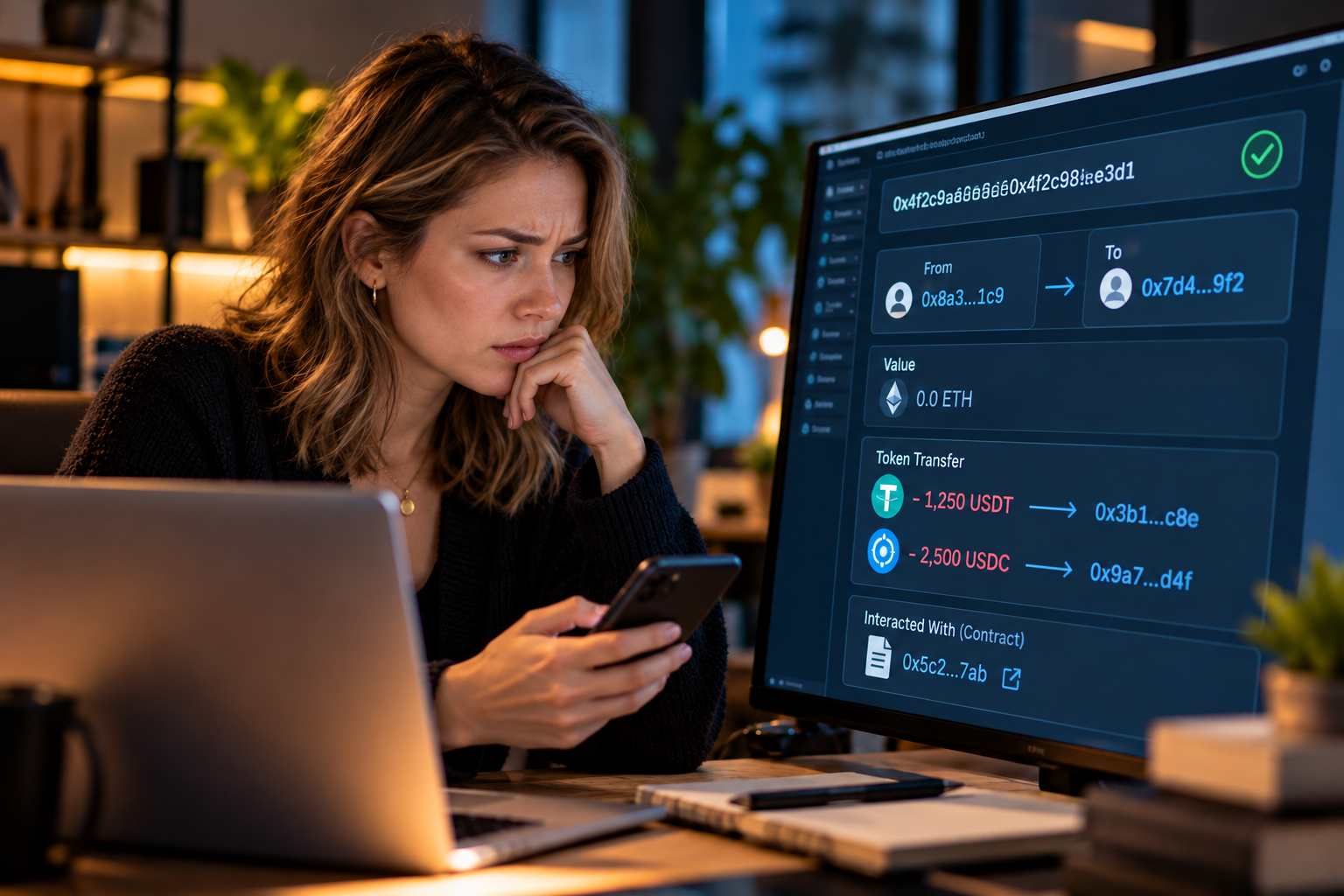
A wallet notification that you did not plan is not yet a story about a hack. It is a transaction, or a token transfer inside one. The fields will say more than the notification title. Read them before you decide what happened, and before anyone in a chat tells you to type a seed phrase in order to “reverse” it. Nothing in a confirmed transaction asks for your phrase.
Start with what actually moved
On Bitcoin, identify the inputs and the outputs. Which earlier outputs were consumed, and which addresses received new ones? The fee is the difference. If the wallet did not initiate it, someone else could satisfy the spending condition: a copied key, a phrase that left the device, or a script you had already set up. The transaction will not name a culprit. It will name the outputs.
On Ethereum, separate ETH value from token transfers. The transaction’s value field is ETH, in wei. A token move is an event inside a token contract, often the result of transfer or transferFrom. Your account’s ETH balance can be unchanged while a token balance falls. The “to” field on the transaction may be a router or a token contract, not the person who ended up with the asset. Open the token contract address and the logs if the notification only says “transfer.”
Ask which permission was used
If you signed the transaction, the wallet should have a record of the signature request: the chain, the nonce, the destination, the value, and the data. The nonce tells you whether this was the next transaction from that account or something older that finally got mined. If you did not sign it, an ERC-20 transferFrom means a spender you had already approved used an allowance. That is a different problem from a stolen key. Revoking the allowance stops further spends of that budget. It does not pull back the transfer that already succeeded.
A transaction that only approves a spender will not move tokens at the moment you see it. The risk is the allowance it writes. A transaction that moves tokens to an address you do not recognize has already done the thing an approval only permitted. Do not send a second transaction that a stranger claims will cancel the first, unless you can read that it does something you intend. A second signature can be the actual theft.
What not to do with the reading
Do not treat a familiar token name as proof of a familiar contract. Names are not unique. The contract address is the identity. Do not treat a block explorer’s label, “hack” or “phishing,” as something the chain recorded. Labels are added by the site. And do not answer a message that uses the transaction as a reason to request the seed, a remote-control login, or a “refund” signature. The readable fields are the destination, the asset, the amount, and the permission that made the move possible. Those are enough to decide whether to revoke an allowance and whether to move remaining funds to a new key.
The chain and the nonce are part of the reading
A transaction is signed for a particular chain. EIP-155 put a chain identifier into Ethereum transactions so a signature for one network is not a valid signature for another. A wallet that is pointed at an unexpected network can still show a request that looks familiar. The asset on that network may be a different contract that reused a name. Before you decide what moved, read the network the wallet says it signed for, not the network the website’s banner advertised.
Then read the nonce against the account’s history. A gap, or a nonce you do not remember signing, means a transaction exists that you have not accounted for. It may be old and only now mined. It may be a replacement of one you abandoned. It may be a sign that another signer has the key. The nonce will not name that signer. It will tell you the account’s sequence is not the sequence you remember, which is the moment to stop signing new requests and to move, from a clean device, anything the unexpected transaction did not already take.
Sources
- Ethereum.org, Transactions.
- EIP-20, on
transferFromand allowances. - Bitcoin Developer Reference: transactions.
- EIP-155, chain identifiers in signed transactions.