




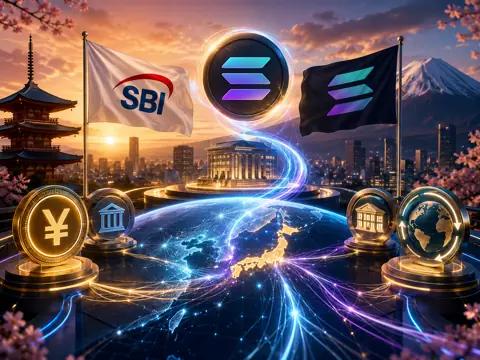
Japanese financial groups SBI Holdings and Sumitomo Mitsui Financial Group (SMFG) have launched a joint venture with the Solana Foundation to develop stablecoin payments, tokenized financial assets and blockchain-based investment services.
The organizations announced on November 25, 2026, that SBI R3 Japan had completed its transition into SBI Solana Global and begun full-scale operations under the new business structure.
The initiative aims to connect Japan’s established financial institutions with blockchain-based markets, although many of its proposed services remain under development.
SBI Solana Global begins operations
According to the joint announcement, SBI Solana Global will combine the financial networks and expertise of SBI Holdings and the SMBC Group with Solana’s blockchain infrastructure.
The venture builds on a strategic partnership announced in July 2026, when SBI and the Solana Foundation outlined plans to develop digital-asset markets originating in Japan.
The companies have now completed the agreements necessary for the new joint venture structure.
The Solana Foundation will collaborate with SBI Solana Global to support future business development and international expansion.
However, the announcement does not disclose detailed financial terms, ownership percentages or the capital committed to the venture.
Stablecoin payments become a central priority
One of the venture’s main objectives is to develop domestic and international payment infrastructure using stablecoins.
Stablecoins are digital tokens designed to maintain a relatively stable value against an underlying asset, usually a national currency.
They can support transfers across blockchain networks without requiring every transaction to move through conventional correspondent banking arrangements.
SBI Solana Global intends to explore payment and remittance services that could operate across national borders.
The venture also identified micropayments conducted by artificial intelligence agents as a potential application.
However, the announcement does not establish that a new commercial stablecoin payment network has already launched.
Its effectiveness will depend on regulatory requirements, integration with existing financial systems and actual customer adoption.
Tokenized financial assets form another focus
Beyond payments, SBI Solana Global plans to develop services involving tokenized financial instruments.
Tokenization involves representing ownership rights or financial claims through digital records maintained on blockchain infrastructure.
The venture identified bonds, investment funds and loan receivables as potential assets that could be issued or distributed through blockchain-based systems.
It also intends to explore tokenization of real-world assets, including commodities and other nonfinancial assets.
Such systems may offer additional methods of recording ownership, transferring assets and verifying transaction histories.
However, representing an asset on a blockchain does not automatically establish its legal ownership, liquidity or market value.
The rights associated with tokenized assets must still be supported by enforceable legal and operational arrangements.
Solana provides blockchain infrastructure
The initiative will draw on Solana’s high-throughput, low-cost blockchain infrastructure and its network of developers and service providers.
The companies intend to connect traditional financial services with on-chain markets where assets can potentially be issued, traded and settled outside conventional banking hours.
SBI Solana Global also plans to develop asset-management services involving stablecoins and tokenized securities.
Its longer-term objective is to connect payments, asset issuance, distribution and investment management through shared blockchain infrastructure.
Nevertheless, the announcement does not establish that these functions are fully integrated or operating commercially.
Japan serves as the starting point
The organizations plan to establish practical financial applications in Japan before expanding their activities across Asia and other international markets.
Japan’s existing banking and securities infrastructure provides an institutional foundation for the initiative.
The partnership may also create opportunities for cross-border investment and financial services using blockchain-based assets.
However, international expansion will depend on local regulations, participating financial institutions and the availability of suitable settlement arrangements.
No complete timetable has been disclosed for introducing the planned services across individual markets.
What the announcement does not prove
The November 25 announcement confirms that SBI Solana Global has begun operations under its new structure.
It does not establish that all proposed stablecoin payment, tokenization and asset-management products are already available.
Nor does the collaboration prove that Solana’s SOL token will experience increased investment demand or price appreciation.
The companies have not disclosed independently measured transaction volumes, cost savings or revenue generated by the new venture.
The distinction matters because creating financial infrastructure is different from demonstrating widespread commercial adoption.
For Japan’s digital-asset sector, the launch represents a concrete institutional commitment to developing on-chain financial services.
Its longer-term significance will depend on the products delivered, their regulatory compliance and whether they offer measurable advantages over existing financial systems.