




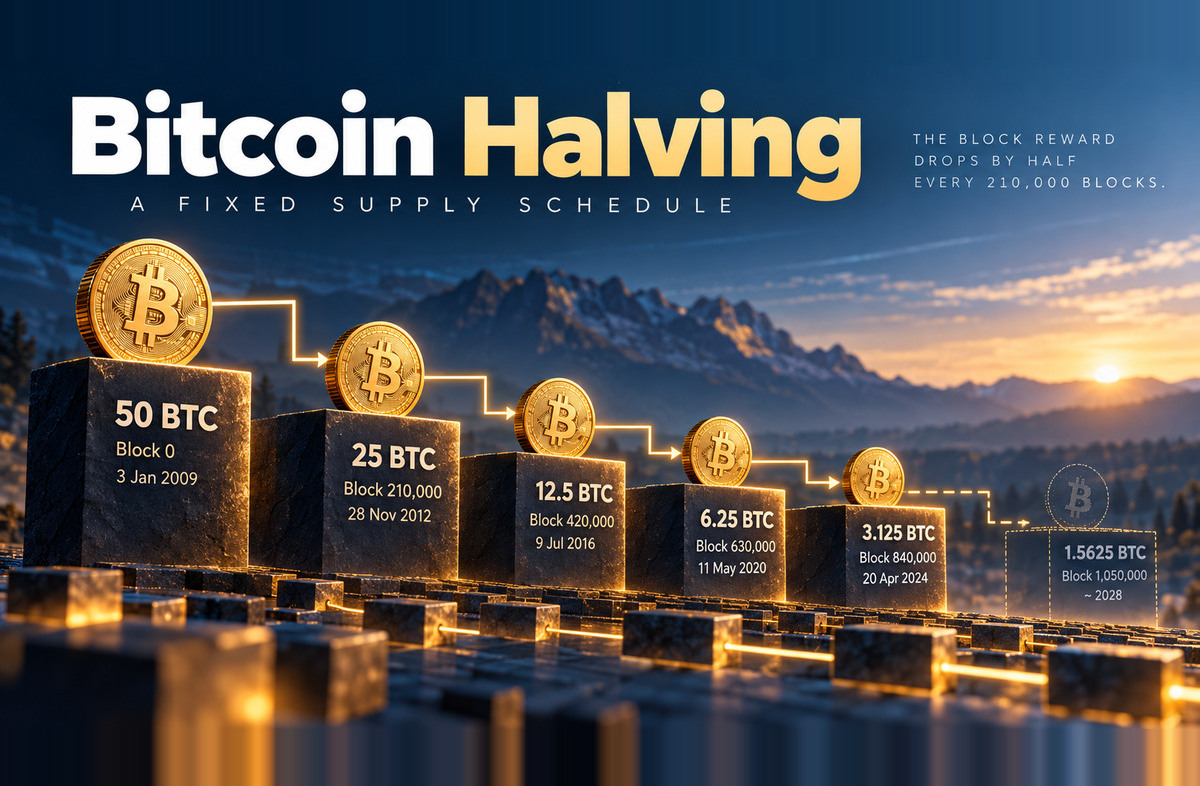
New bitcoin enters circulation as a subsidy inside the coinbase transaction of each block. The protocol cuts that subsidy in half on a fixed block schedule. The event is called the halving. It is not a vote, a company announcement, or a rule that the market price must rise.
The schedule in blocks, not in calendar years
The subsidy started at 50 bitcoin per block. It falls by half every 210,000 blocks. Bitcoin’s design aims at about one block every ten minutes, so 210,000 blocks is often described as about four years. The calendar date moves if blocks arrive faster or slower than that target. The rule itself is the block height.
Bitcoin.org’s halving record lists the first cut at block 210,000 on 28 November 2012, when the subsidy became 25 BTC. The second was block 420,000 on 9 July 2016, to 12.5 BTC. The third was block 630,000 on 11 May 2020, to 6.25 BTC. The fourth was block 840,000 on 20 April 2024, to 3.125 BTC. The next scheduled cut is block 1,050,000, with a subsidy of 1.5625 BTC. The site estimates that height around 2028, and it says the estimate moves with the live chain.
Subsidy, fees, and the 21 million figure
The coinbase transaction may also collect the fees from the block’s other transactions. The halving cuts the subsidy, not the fees. The subsidy is expected to reach zero around the year 2140. That year is a calendar estimate from the fixed block schedule, not a change to the block height. After the subsidy rounds down to zero, miners would be paid only by fees if they still find the work worth doing. That is a design consequence, not a forecast that fees will be high enough.
Adding the subsidy series produces a cap of 21 million bitcoin. In the software, amounts are integers in the smallest unit, and the subsidy is right-shifted at each era, so the amount that can actually be issued is slightly under that round number. “21 million” is the right way to describe the cap in ordinary language. It is not a treasury that already holds 21 million coins.
What the halving does not do
The halving does not change the validity rules for ordinary transactions. It does not burn existing coins. It does not set a price, a hashrate, or a fee level. Markets may react to the change in new supply, and miners may change behavior because a larger share of their block reward comes from fees. Those are economic responses. They are not instructions in the halving rule.
A useful check, when a headline treats the date as destiny, is to separate three sentences. The subsidy changed at a known block. The calendar date of a future block is an estimate. The price afterward is not a field in the protocol.
How to check the claim without a countdown site
The height is public. A full node, or any block explorer that shows block height, will tell you how many blocks have been found. Divide the distance to the next multiple of 210,000 by the recent pace of blocks if you want a calendar guess, and then throw the guess away the moment the pace changes. The protocol will not halve early because a market event arrived, and it will not wait if blocks are coming in faster than ten minutes. The next era begins at the height, in the coinbase of that block, when the subsidy the software allows is half of what it was the block before, subject to the integer arithmetic of the smallest unit.
It is also worth separating new issuance from the coins already outstanding. A halving does not touch a single existing output. Someone who held bitcoin the block before the halving holds the same outputs the block after, unless they spend them. The change is only in the amount the coinbase of a new block may create. Commentators who say the supply was “cut in half” are talking about the flow of new coins, not the stock. The stock keeps growing, more slowly, until the subsidy rounds to zero. That is the schedule. A price chart laid beside it is a second document, and the protocol does not read it.
Sources
- Bitcoin.org, Bitcoin halving, including the historical table of blocks, dates, and new rewards.
- Bitcoin white paper, on the declining subsidy.
- Bitcoin Developer Reference: block chain, on the coinbase transaction.