




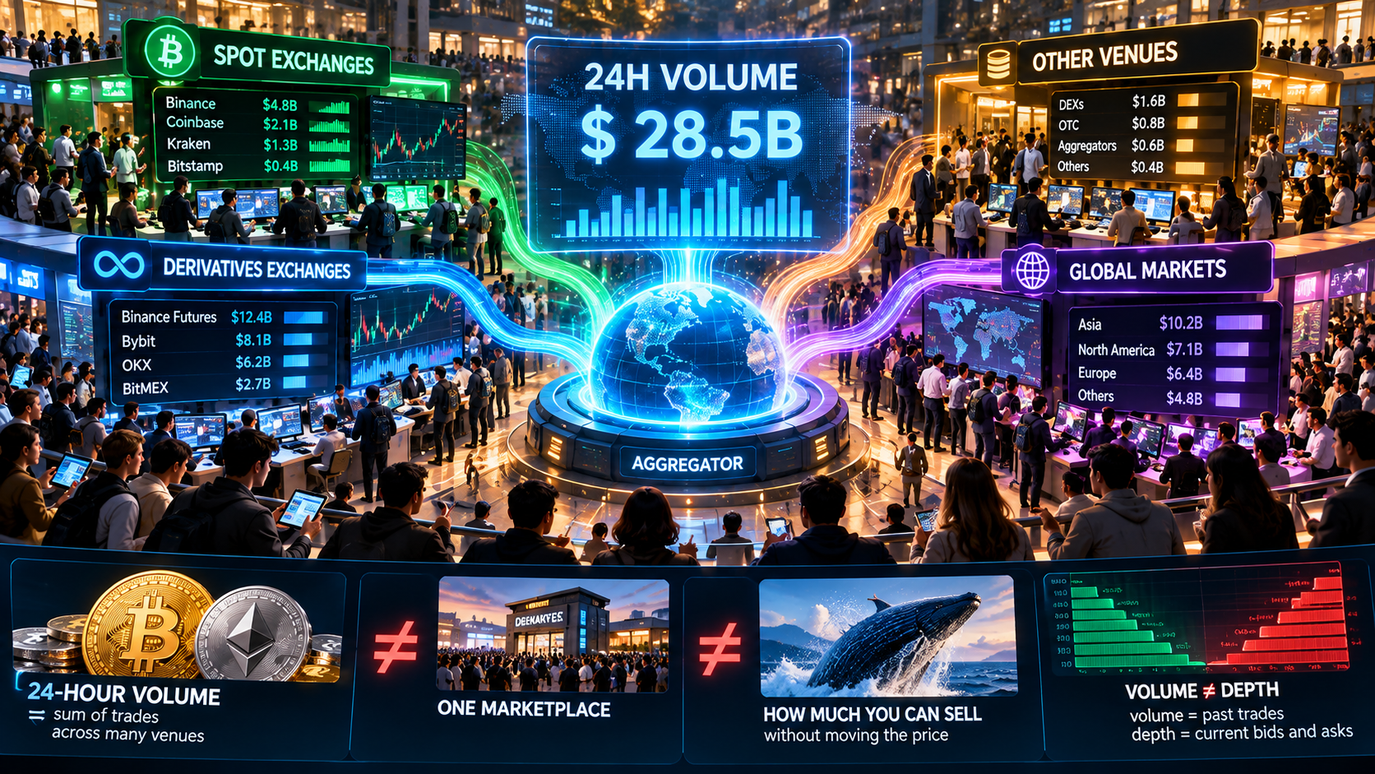
Volume is a sum of trades. A “24-hour volume” for bitcoin is somebody’s decision about which trades, on which venues, over which clock, expressed in coins or in dollars. Read as a single marketplace, the number will mislead you even when every input trade was real.
What gets added
A spot exchange counts its own trades. A derivatives exchange counts contracts, which may be notional amounts rather than coins delivered. An aggregator then adds venues together. Some aggregators try to exclude venues whose volume does not line up with observable order books or with web traffic. Others add what venues report. The same word, volume, covers all of these choices. Two dashboards can differ by a wide margin without either one having “forgotten” a trade. They drew different boundaries.
The unit matters as much as the boundary. A million coins and a million dollars are not neighbors. A perpetual contract with a notional of one bitcoin is not one bitcoin changing hands on the spot market. Adding spot coins to futures notionals produces a number that is easy to print and hard to interpret. Serious comparisons say which market type they include.
Volume is not depth
A busy day can still have a thin book. Volume looks backward at prints. Depth looks at the bids and offers resting now. You can print a large volume with many small trades and still find that a single large order would walk through the book. You can also see a large print that was arranged, or a trade between related accounts. This article does not assign a percentage to that problem. The honest statement is narrower: reported volume is not, by itself, evidence that unrelated buyers and sellers met in size.
Wash trading and incentive programs are the reason some researchers distrust raw venue reports. The right response is to ask how the figure was built, not to replace it with a guessed “real” number. If a compiler publishes the venue list and the filters, you can disagree with the filter. If it publishes only a total, you have a label.
Use a 24-hour figure to answer a 24-hour question: how much activity did this compiler count. For “can I trade this size,” look at the book and at recent prints on the venue you will actually use. Those are smaller numbers, and they are the ones that correspond to a marketplace.
Notional is a different unit
A perpetual trade is often reported as a notional amount: price times contract size. Ten contracts notionally worth one bitcoin each can print as ten bitcoin of volume without ten bitcoin moving on chain or even between spot accounts. A spot trade of ten bitcoin moves ten bitcoin, or a claim to them, between the two sides. Adding the two figures because both are labeled BTC produces a total that no single desk traded. Dollar volume has the same trap if one compiler converts at its own index and another converts at the venue’s last price.
The clock is a quieter version of the same problem. A 24-hour window ending at midnight UTC is not the window ending at 4 p.m. New York, and a rolling 24-hour window moves every time you refresh it. A record “daily volume” can be a calendar day, a session, or a trailing day. None of those choices is wrong. They are unpublished if the caption does not include them. When you cite a volume number, cite the compiler, the window, and whether the sum is spot, derivatives, or both. The number is then a statement someone can recompute. Without those three words it is a sticker. Depth is the neighboring number that still has to be read separately: the bids and offers resting now, on the venue you will use, in the size you actually want to trade. Volume does not contain that book. The resting book, not the trailing total, is what you can actually trade.
Sources
- SEC Release No. 34-99306 discusses surveillance and pricing sources in the context of spot bitcoin exchange-traded products, a reminder that “the market” in a filing is a defined set of venues.
- CF Benchmarks documentation, on how an index states the constituent exchanges it will and will not use.