




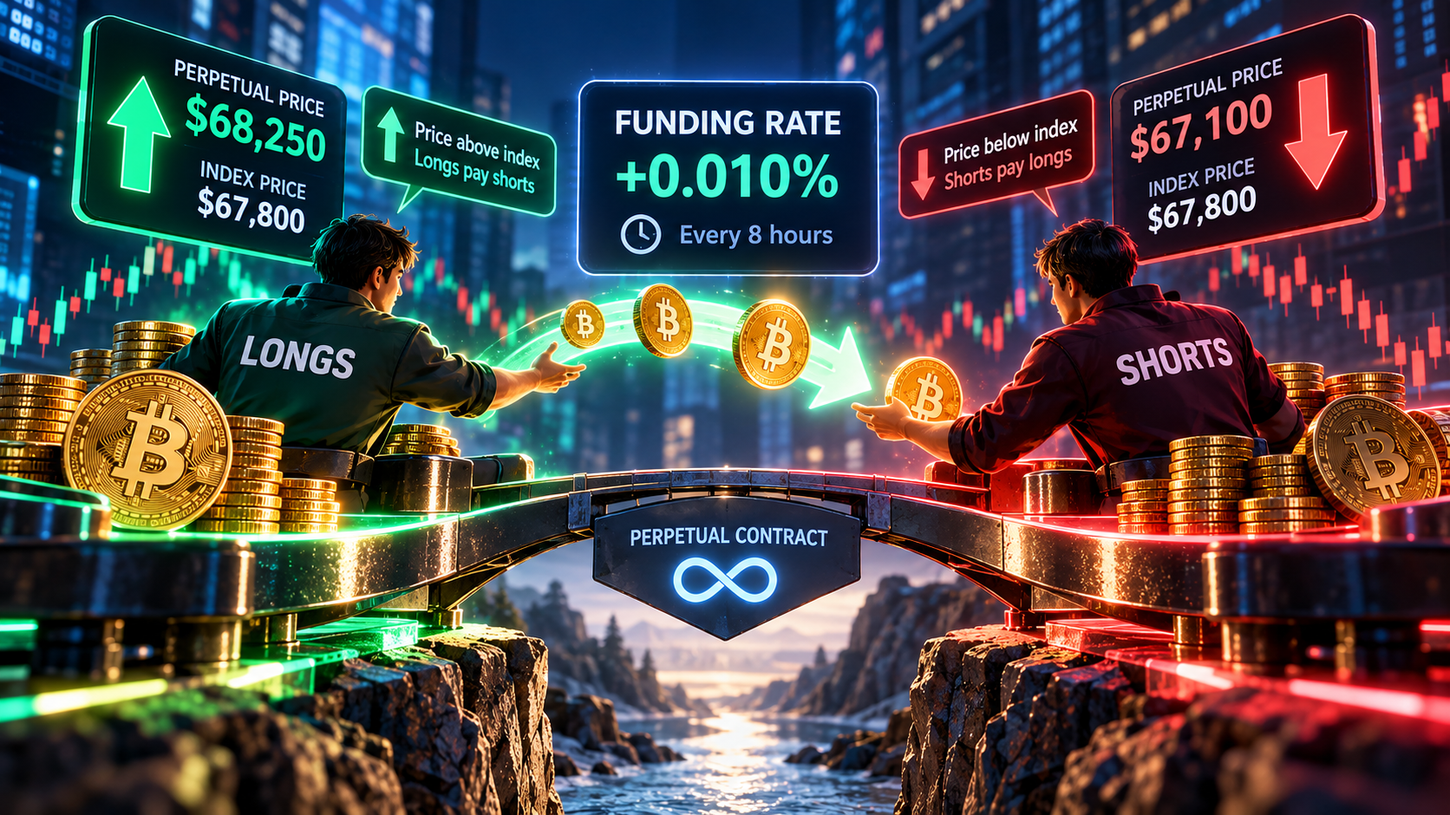
A funding rate is a number attached to a perpetual futures contract. At a set interval, one side of the market pays the other. The rate says how much, and the sign says which way. That is the description. Everything else is an interpretation laid on top.
Who pays, and for what
Perpetual contracts do not expire, so they need a mechanism to keep the contract price from drifting away from a spot index forever. Funding is that mechanism. When the contract trades rich to the index, the long side generally pays the short side. When the contract trades cheap, the short side generally pays the long side. BitMEX’s perpetual guide is one primary write-up of this design. Other venues publish their own formulas. The interval is often eight hours. It is a venue rule, not a property of bitcoin or ether, and a different venue can choose a different clock.
The payment is usually proportional to position size. A higher rate costs more to hold the crowded side. Traders treat that cost as a reason to lean the other way, which is how the contract is pulled back toward the index. The protocol of the underlying chain does not collect this payment. The two sides of the book do.
What it does not say
A positive funding rate is not a dividend, a yield on the coin, or a statement that the coin “should” go up. It is evidence that longs were willing to pay, over that interval, to keep leveraged long exposure. A negative rate is evidence that shorts were willing to pay. The next interval can flip. A published rate is also not a promise that you will collect it: if your position is closed, liquidated, or below the venue’s threshold, you may not.
Read it next to the premium it is responding to. The rate without the gap between contract and index is just a fee. The gap without the rate is an unpriced disagreement. Together they describe how expensive it currently is to lean on the perpetual.
Venues also publish how the rate is built, and the formulas are not identical. A common design blends a premium, the gap between the contract and an index, with an interest-rate component meant to mimic a difference in borrowing cost between the quote currency and the coin. The weights and the caps are in that venue’s document. Some venues cap the rate. Some change the interval when the premium is large. Quoting “the funding rate” as if it were a single worldwide number mixes those documents. Quote the venue, the interval, and the side that pays. Then it is a description again, which is all the rate ever was.
Sources
- BitMEX, perpetual contracts guide.
- Binance Futures, introduction to funding rates, as an example of a venue stating its own interval and formula.