




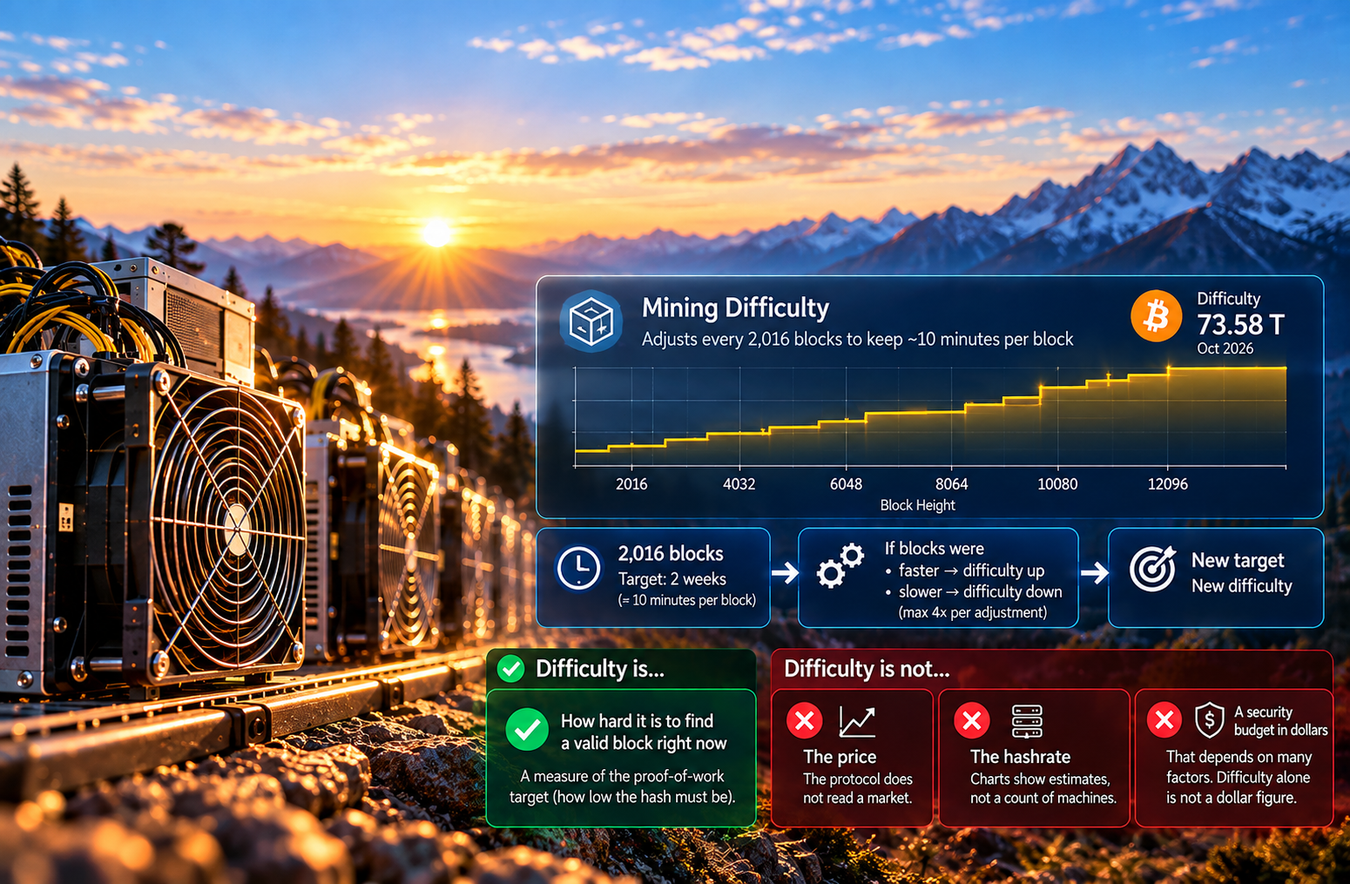
Difficulty is a way of writing the proof-of-work target. A valid block header must hash to a number at or below that target. A lower target means more work is required, on average, before someone finds a header that qualifies. That is the whole measurement: how low the hash has to land.
Why it moves
Bitcoin wants blocks about every ten minutes. Every 2,016 blocks, nodes look at how long those blocks actually took. The expected span is two weeks. If the span was shorter, the target falls and difficulty rises. If the span was longer, the target rises and difficulty falls. The adjustment is limited to a factor of four in either direction, so one period cannot multiply or divide the target by more than four.
The result is a feedback loop on time, not on price. Miners add or remove machines for their own reasons. Difficulty only notices the effect on block intervals.
What people slide in under the word
- Hashrate. A chart of estimated hashrate is inferred from difficulty and recent block times. It is an estimate of work, not a census of machines.
- Price. The protocol does not read a market. A higher coin price may attract miners, and that may later raise difficulty. The difficulty number itself is not a price.
- A dollar “security budget.” The cost of attacking the chain depends on hardware, energy, the honest hashrate, and how long the attacker must keep going. Difficulty is one input to that conversation. It is not a dollar figure.
When a headline says difficulty “hit a new high,” the precise claim is that the target just got harder. Ask separately whether blocks are still near ten minutes, and do not treat the number as a verdict on price or safety.
The number people usually quote is a rescaling, not a second measurement. Difficulty expresses the current target relative to the easiest target the protocol defined, so a larger difficulty means a smaller target. You can talk entirely in targets and never use the word. Miners do. They hash a header and ask whether the result is at or below the target in nBits. Charts invert that into a difficulty index because a rising index is easier to read than a falling 256-bit number. Both descriptions are the same fact. Neither description is a count of machines, a dollar security budget, or a prediction that the next 2,016 blocks will actually take two weeks. The next retarget is where that prediction gets corrected, and the correction itself cannot move the target by more than a factor of four.
Sources
- Bitcoin white paper, proof-of-work section.
- Bitcoin Developer Guide: block chain, on the difficulty adjustment.
- Bitcoin Wiki, Difficulty, on the target and the 2,016-block retarget.