




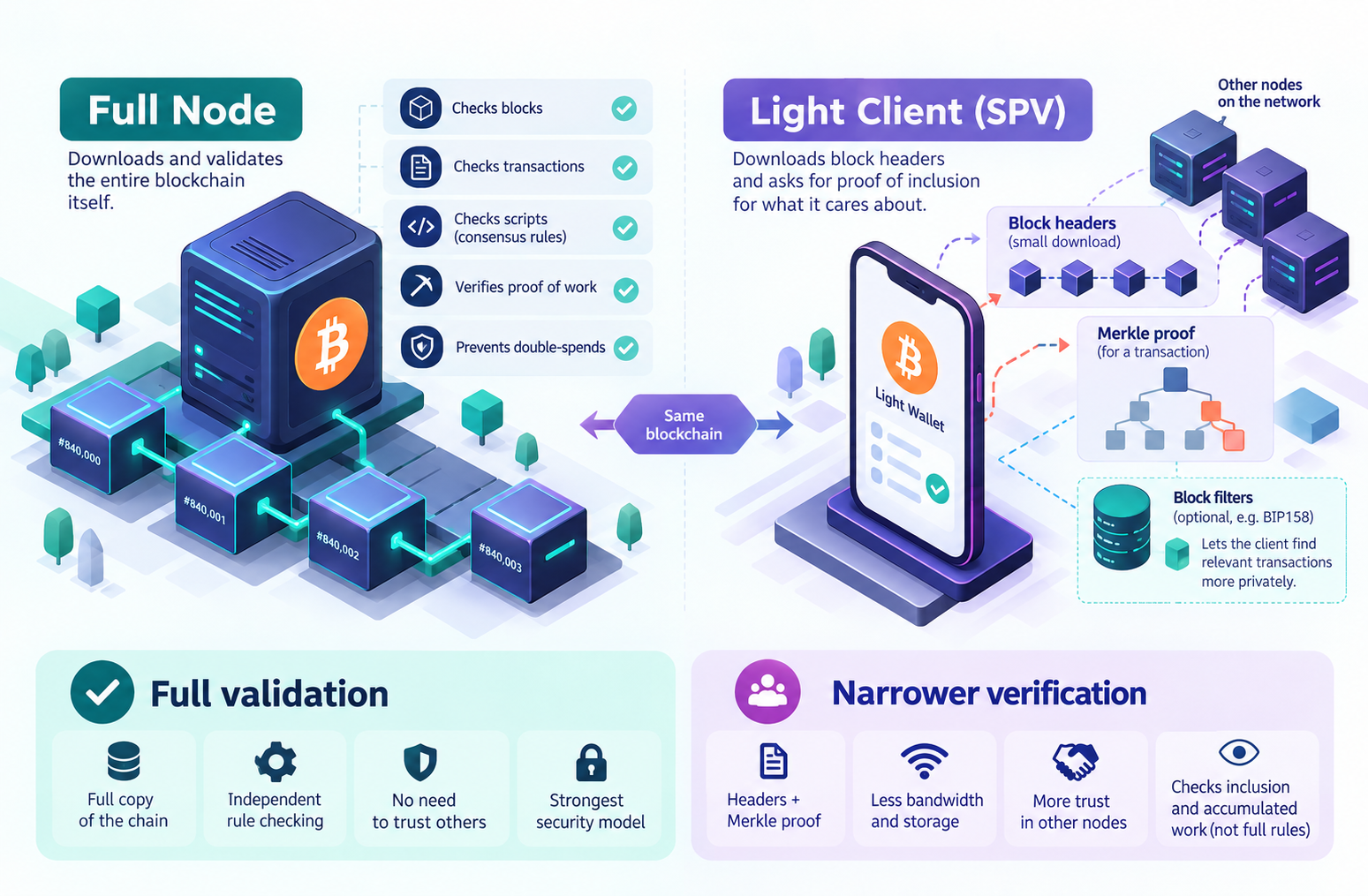
Bitcoin software is not one product. Some programs download blocks and check every rule they can. Others try to answer a narrower question: is this payment included, and how much work sits on top of it? The first is a full node. The second is a lightweight client. They are useful for different jobs, and they fail in different ways.
What a full node is for
A full node keeps the block chain, or enough of it to validate, and applies the consensus rules to blocks and transactions. It checks proof of work, the subsidy, the scripts, and the rule that an output cannot be spent twice. When two competing blocks appear, it follows the valid chain with the most work. It does not need a company to tell it which payment counted.
The featured image says a full node has no need to trust others. That means the node checks the consensus rules itself. It still depends on other peers for blocks it has not yet received.
That independence has a cost. The node uses disk, bandwidth, and time. It is the right tool when the question is “what does the protocol say?” It is an awkward tool if you only want a balance on a phone.
What a light client gives up
The white paper’s simplified payment verification, often called SPV, lets a client download headers and a Merkle path for a transaction. The path shows that the transaction is committed in a header. The chain of headers shows how much work followed. The client does not recheck every script in every block.
Section 8 of the Bitcoin white paper describes the security tradeoff of simplified payment verification. The light check works while honest nodes control the network, but it is more vulnerable if an attacker overpowers the network. Privacy is a separate problem. BIP 37 bloom filters tell a server which transactions the client cares about. BIP 157 lets the client download a compact block filter and test it locally, so that list is not sent to the server. A light client can still be shown a payment that a full node would reject, if the client is not checking the rule that makes it invalid.
Filters are not the same as full validation
Later proposals, BIP 157 and BIP 158, describe compact block filters. A client can fetch a filter for a block, test whether anything it cares about might be inside, and download the block only when the filter matches. That reduces bandwidth and can improve privacy compared with asking a server for specific transactions. It still does not turn the phone into a full node. The client is still not replaying every historical rule unless it downloads and checks the blocks.
A practical way to choose: if you are checking your own receipts and you accept the risk that you are trusting miners and the servers you talk to, a light wallet is a product decision. If you are deciding whether a rule change has activated, or whether a large payment is valid under the rules you intend to enforce, you want software that checks the chain itself. Many people use both. The mistake is to describe them as the same kind of evidence.
Privacy is a third difference
A full node can learn about payments by reading the chain it already stores. A light client that asks a server “do you have transactions for these addresses?” tells that server the addresses. BIP 37 bloom filters were an early attempt to soften that question by asking for a fuzzy set. They still leak information, and they cost the serving node work. BIP 157 reverses the direction. The node publishes a compact filter of the block. The client downloads the filter and tests it locally. Only a match requires fetching the block. That is a better privacy design. It remains a light-client design. The client is still not the software that decided the block was valid.
There is a social version of the same split. A block explorer is someone else’s full node with a website in front of it. It is useful, and it is not your node. When the explorer and your own node disagree, the disagreement is the moment the distinction stops being theoretical. One of them has not seen a block, or one of them is applying a different policy to unconfirmed transactions. Confirmed history should not differ between two honest full nodes on the same chain. Unconfirmed history can, because mempools are local. A light client that only speaks to one explorer cannot see that argument. It can only repeat the explorer.
Sources
- Bitcoin white paper, section 8, simplified payment verification.
- BIP 157, Client Side Block Filtering.
- BIP 158, Compact Block Filters.
- BIP 37, bloom filters, an older light-client design with weaker privacy.